Active Voice vs Passive Voice in 2026:Which Is Better for Readability, SEO, and AI Writing?
If you've ever written a blog post, school assignment, email, or even edited content generated by AI, you've probably heard the same advice: use active voice whenever possible.
For years, I treated that advice like a hard rule. Whenever I spotted a passive sentence, I rewrote it immediately. Over time, I realized the situation is more nuanced than most writing guides suggest.
Some passive sentences genuinely feel awkward and unnecessarily complicated. Others sound completely natural and are actually the better choice. The goal isn't to eliminate passive voice. The goal is to understand when each style helps the reader.
That matters more today than ever. Students, bloggers, marketers, freelancers, business owners, and AI users spend a significant amount of time editing content for clarity and readability.
While building writing tools for NexoText, I found myself fixing the same passive constructions over and over again. That's one reason I eventually created the Passive to Active Voice Converter — to speed up editing without forcing writers to manually rewrite every sentence.
In this guide, you'll learn the difference between active voice and passive voice, when to use each one, how they affect readability, and whether they have any impact on SEO and AI writing in 2026.
Table of Contents
Quick Answer
Active voice is usually easier to read because the subject performs the action directly. Passive voice shifts the focus toward the action or the result instead of the person performing it.
For most blog posts, emails, website content, marketing copy, and AI-generated articles, active voice is generally the better choice because it feels clearer, more direct, and easier to understand.
Passive voice still has an important role. It works well when the actor is unknown, unimportant, or when the outcome deserves more attention than the person responsible for the action.
What Is Active Voice?
Active voice is a sentence structure where the subject performs the action.
At its core, active voice simply means the subject performs the action.
This is the sentence structure most people naturally use when speaking, writing emails, or having everyday conversations.
Active Voice Examples
- Sarah wrote the report.
- The teacher explained the lesson.
- The company launched a new product.
- The developer fixed the bug.
Notice how every sentence immediately tells you who performed the action.
Because active voice is direct and concise, it is commonly used in blog posts, marketing content, business communication, journalism, website copy, and everyday writing.
Readers usually process active voice more quickly because they do not have to work out who performed the action.
What Is Passive Voice?
Passive voice changes the focus of the sentence.
Instead of highlighting the person performing the action, passive voice highlights the object receiving the action.
The action still happens, but the actor becomes less important.
Passive Voice Examples
- The report was written by Sarah.
- The lesson was explained by the teacher.
- A new product was launched by the company.
- The bug was fixed by the developer.
These sentences are grammatically correct. They simply place emphasis on the result rather than the actor.
Passive voice often appears in scientific papers, formal reports, legal documents, and situations where the actor is unknown or unimportant.
Many people assume passive voice is automatically bad writing.
The real skill is knowing when it helps the reader and when it gets in the way.
Difference Between Active and Passive Voice
The easiest way to understand the difference between active voice and passive voice is to compare the same idea written both ways.
| Active Voice | Passive Voice |
|---|---|
| Sarah wrote the report. | The report was written by Sarah. |
| Google updated the algorithm. | The algorithm was updated by Google. |
| The manager approved the proposal. | The proposal was approved by the manager. |
| The editor published the article. | The article was published by the editor. |
Both versions are grammatically correct.
The difference is focus.
Active voice focuses on the actor. Passive voice focuses on the receiver of the action.
Quick Comparison
- Active voice is usually shorter.
- Active voice is often easier to read.
- Active voice feels more direct.
- Passive voice can sound more formal.
- Passive voice is useful when the actor is unknown.
- Both styles are grammatically correct.
Understanding this distinction is important because sentence structure affects how readers experience your content.
Whether you're writing a school assignment, blog post, business email, landing page, or AI-assisted article, the voice you choose can make content feel either clear and engaging or unnecessarily complicated.
Why Active Voice Improves Readability
Most readers do not consciously analyze sentence structure while reading. They simply notice whether a piece of writing feels easy or difficult to follow.
Active voice often feels easier because it follows the same pattern people naturally use in conversation. Someone performs an action, and the reader immediately understands what happened.
Compare these two versions:
Passive Voice
The marketing campaign was launched by the team.
Active Voice
The team launched the marketing campaign.
Both sentences are correct. The active version simply gets to the point faster.
This difference becomes more noticeable in long articles, reports, business documents, and website content where readers are processing dozens or even hundreds of sentences.
Clear writing reduces mental effort. Readers spend less time interpreting sentences and more time understanding your message.
That is one reason many writing style guides recommend active voice for most situations.
Why Readers Prefer Active Voice
- It is usually shorter.
- It feels more direct.
- It improves clarity.
- It helps readers identify the actor immediately.
- It often sounds more natural in modern writing.
Active Voice vs Passive Voice for SEO
One of the biggest SEO myths online is that Google directly ranks pages based on active voice.
There is no public evidence that Google uses an "active voice score" as a ranking factor.
However, active voice can still help indirectly because it often makes content easier to read and understand.
Good SEO is not only about keywords. It is also about creating a better experience for readers.
Example
Passive:
The guide was created to help users learn SEO.
Active:
We created this guide to help users learn SEO.
The active version feels more conversational and more human.
That is one reason many bloggers and content creators naturally lean toward active voice when writing for online readers.
Active Voice vs Passive Voice for AI Writing
AI writing tools have become part of everyday workflows for students, bloggers, marketers, and businesses.
While AI can generate content quickly, some drafts sound more formal than necessary because they contain too many passive constructions.
This doesn't mean AI always writes in passive voice. It simply means passive sentences tend to appear more frequently than many human writers would naturally use.
AI Writing Example
Passive:
The report was generated and the findings were analyzed.
Active:
The system generated the report and analyzed the findings.
The active version feels more direct because readers immediately know who performed the action.
When editing AI-generated content, I usually start by looking for sentences that sound indirect or unnecessarily formal. Rewriting a few of those sentences often makes the entire paragraph easier to read.
Still, there are plenty of situations where passive voice works perfectly well.
Some passive sentences sound completely natural and fit the context better. The best results usually come from using both styles intentionally rather than forcing everything into one format.
Quick Takeaway
For most blog posts, marketing content, website copy, and AI-edited articles, active voice should be your default choice. Passive voice should be used when it genuinely improves the sentence or shifts the focus where it belongs.
When Passive Voice Is Better
After reading this far, you might think active voice should always be used.
Not quite.
Strong writing is not about following rigid rules. It is about choosing the sentence structure that communicates your message most effectively.
While active voice is usually the better default choice, there are situations where passive voice sounds more natural, professional, and even clearer.
1. When the Actor Is Unknown
Sometimes you simply do not know who performed the action.
The window was broken overnight.
We know what happened, but we do not know who caused it. In cases like this, passive voice feels completely natural.
2. When the Result Matters More
In some situations, the outcome is more important than the person responsible.
The vaccine was approved after extensive testing.
Most readers care more about the approval itself than the individuals involved in the process.
3. Academic and Scientific Writing
Research papers often focus on the experiment and findings rather than the researcher.
The samples were analyzed in a controlled environment.
This style helps maintain an objective and formal tone.
4. Professional Communication
Businesses often use passive voice when creating neutral and professional messages.
Your request has been received.
This keeps the focus on the action rather than the company representative.
Key Takeaway
Passive voice is not bad writing. Problems arise only when it is overused. The best writers know when to use active voice for clarity and when passive voice helps shift the focus where it belongs.
Real-World Examples
Let's look at examples that students, bloggers, marketers, and professionals encounter regularly.
| Situation | Passive Voice | Active Voice |
|---|---|---|
| Blogging | The article was published yesterday. | The editor published the article yesterday. |
| Your request was received. | We received your request. | |
| Business | The proposal was approved. | The manager approved the proposal. |
| AI Content | The report was generated by AI. | AI generated the report. |
In most cases, the active version feels clearer and more direct.
However, that does not automatically make the passive version wrong. Context still matters.
Try the NexoText Passive to Active Voice Converter
When I started writing longer blog posts, I noticed something interesting.
Most passive sentences weren't technically wrong. They were simply harder to read.
During editing, I found myself rewriting the same sentence patterns again and again. After doing that dozens of times, I decided to build a tool that could help speed up the process.
That's how the NexoText Passive to Active Voice Converter was created. It helps identify passive constructions and makes rewriting much faster, especially when working with essays, blog posts, reports, emails, and AI-assisted drafts.
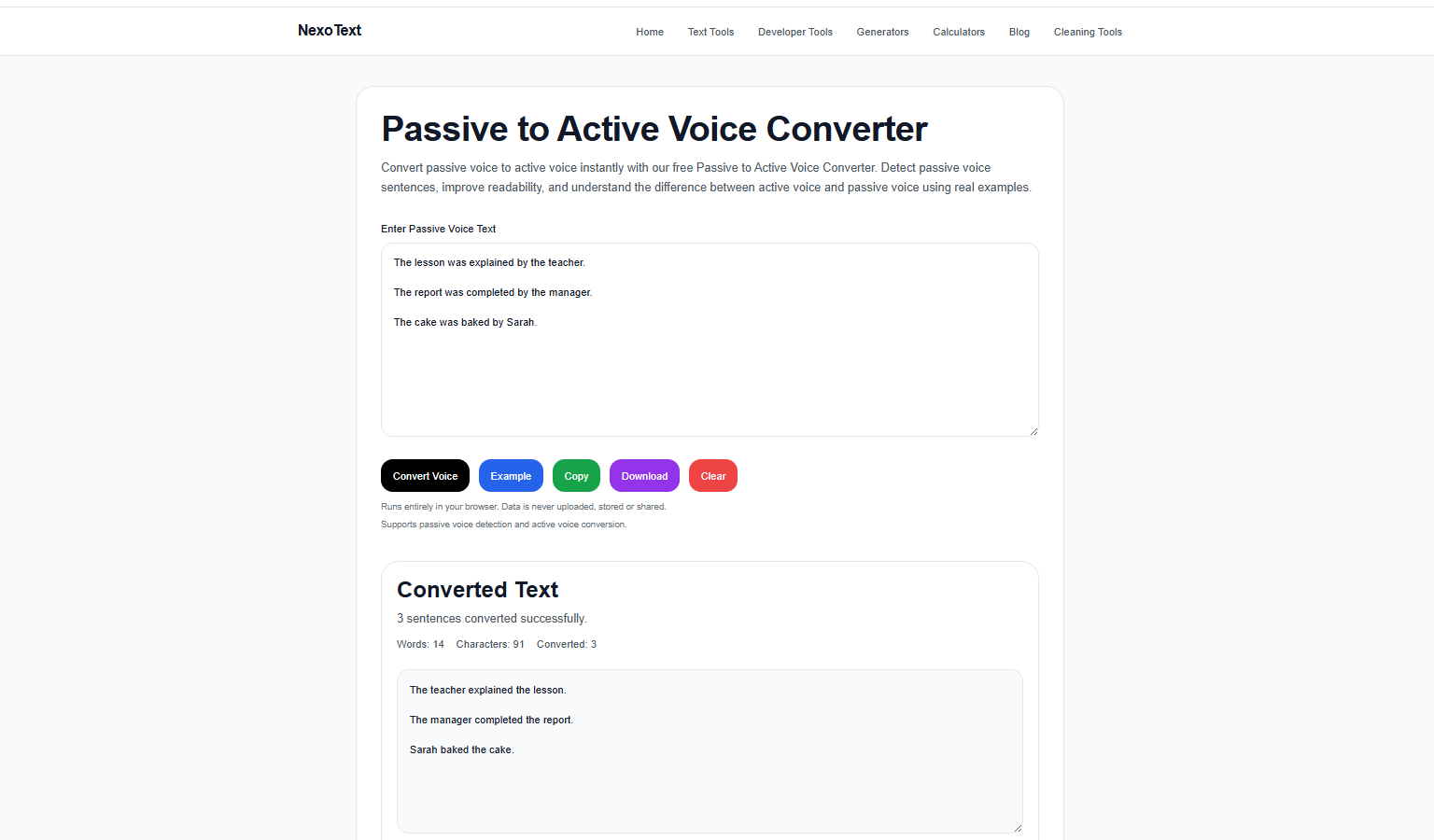
Quick Example
The report was written by Sarah.
Sarah wrote the report.
Sometimes a tiny sentence change like this can make writing feel more natural without changing the meaning at all.
If you regularly edit content, the tool can save a surprising amount of time.
Common Mistakes Writers Make
One of the biggest misconceptions about active and passive voice is that one is always right and the other is always wrong.
In practice, the problem is usually overuse rather than the voice itself.
Mistakes to Avoid
- ❌ Trying to remove every passive sentence.
- ❌ Assuming passive voice is always incorrect.
- ❌ Making sentences longer than necessary.
- ❌ Hiding responsibility behind passive wording.
- ❌ Switching awkwardly between active and passive structures.
What matters most is whether the sentence is easy for the reader to understand. If active voice makes a sentence stronger, use it. If passive voice serves the reader better, use that instead.
Who Should Use Active Voice?
If your goal is clearer communication, active voice will usually help you get there faster.
Related Resources
Passive to Active Voice Converter
Rewrite passive sentences faster.
Text Tools
Explore writing and editing utilities.
NexoText Blog
Read more writing guides and tutorials.
Frequently Asked Questions
Here are the most common questions people ask about active voice, passive voice, readability, SEO, and AI writing.
What is the difference between active voice and passive voice?
Active voice places the actor before the action, while passive voice focuses on the receiver of the action. Both are grammatically correct but serve different purposes.
Is passive voice bad for SEO?
No. Passive voice is not a direct Google ranking factor. However, active voice often improves readability, which can make content easier for visitors to understand.
When should I use passive voice?
Passive voice works well when the actor is unknown, unimportant, or when the result deserves more attention than the person who performed the action.
How do I convert passive voice to active voice?
Identify who performs the action and move that actor to the beginning of the sentence while keeping the meaning unchanged.
Is passive voice grammatically correct?
Yes. Passive voice is completely grammatically correct and is commonly used in scientific, academic, legal, and professional writing.
Final Thoughts
The debate between active voice and passive voice is often presented as if one style is always right and the other is always wrong.
In reality, both have a place in effective communication.
For most blog posts, website content, emails, business writing, and AI-assisted drafts, active voice is usually the better choice because it improves clarity, readability, and engagement.
Passive voice becomes valuable when the actor is unknown, when the outcome matters more than the actor, or when a formal tone is appropriate.
The best writers do not avoid passive voice completely. They choose the sentence structure that best serves the reader.
If you're editing content and want a faster way to rewrite passive sentences, try the NexoText Passive to Active Voice Converter. Small changes in sentence structure can make a surprising difference in how your writing feels.
Ready to Improve Your Writing?
Convert passive sentences into clearer, more direct writing in seconds. Perfect for students, bloggers, marketers, and anyone who wants cleaner content.
Try the Converter →